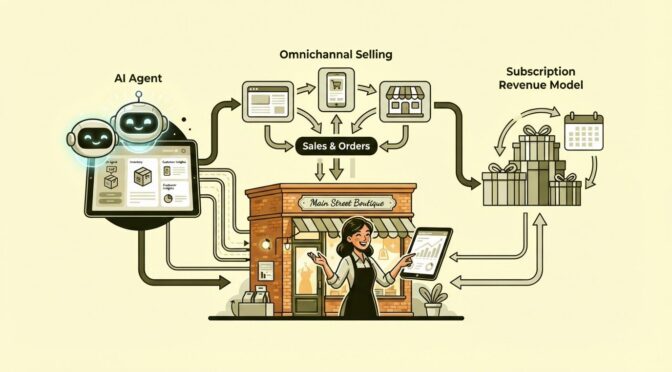
Main-street shops face a difficult scaling problem: customers still value a nearby store, but product discovery, purchasing, and service now happen across more channels than a small team can manage manually. Scaling with AI agents, omnichannel selling, and subscription revenue offers a practical way to serve more customers without treating the storefront as the only place a sale can begin.
The opportunity is not to copy a large chain’s technology budget. It is to connect a shop’s strengths,knowledgeable service, useful inventory, and local convenience,to reliable digital information, flexible fulfillment, and reasons for customers to return. Each part needs its own business case: an AI agent cannot rescue inaccurate product data, a pickup option cannot work without dependable stock visibility, and a subscription is not valuable simply because it renews.
Why main-street shops need a connected growth model
Physical retail remains central to the customer journey. NRF’s 2026 consumer research with IBM found that 72% of consumers still shop in stores. The same research found that 41% use AI assistants to research products, 33% to find reviews, and 31% to search for deals. A customer may therefore begin with an assistant, compare options online, and still expect to inspect or collect an item locally.
That sequence changes what a small shop must make easy. Customers need to know what an item is, whether it suits their needs, what it costs, whether it is available, and how quickly they can get it. A shop that answers those questions consistently across search, its website, messaging, and the counter has a better foundation for growth than one that treats every channel as a separate business.
Direct answer: Main-street shops can scale by making product and inventory information usable by AI-assisted shoppers, connecting online discovery to dependable local fulfillment, and offering recurring services customers genuinely want. Start with one repeatable customer need, measure the full journey where possible, and expand only when service quality and margins hold up.
This is an operating model, not a claim that every shop should build its own shopping agent. Levin Management’s 2026 Mid-Year Retail Sentiment Survey describes retailers accelerating technology investment, embracing AI, and expanding omnichannel services. Toast’s 2026 Voice of Retail Survey likewise found that operators expect AI to help with decision-making, staff productivity, marketing performance, guest experience, and sales and revenue. Those are distinct jobs; choosing the right one matters more than adopting the most features.
There is also a timing gap between interest and actual agent-driven sales. BCG reports that 68% of retailers expect agentic commerce to have a significant or transformational effect within two years, while HFS Research reports that 59% of retail, consumer products, and travel or hospitality enterprises currently receive less than 5% of direct consumer revenue through AI agent-mediated channels. For an independent retailer, that combination argues for preparation and testing, not a sudden rebuild around an unproven source of orders.
Make products easy for AI agents and customers to understand
An AI shopping assistant can only recommend a product confidently when the underlying information is clear. NIQ identifies structured product data, real-time inventory signals, and AI-optimized attributes as important for capturing share as agentic commerce reshapes retail. These requirements sound technical, but for a main-street shop they begin with ordinary merchandising discipline: accurate names, useful descriptions, current prices, clear variants, and a trustworthy indication of availability.
Consider a customer asking an assistant for a gift that can be picked up nearby. A vague listing labeled only with a brand and a price gives the assistant little to work with. A listing that explains the product’s size, materials, intended use, care requirements, pickup options, and availability gives both the customer and the assistant a better basis for deciding whether the item fits.
Build a useful product record before adding automation
Start with a small set of products that customers regularly ask about. Review the questions staff answer in the store and by phone, then make sure product pages answer them in plain language. The goal is not to stuff descriptions with keywords; it is to remove uncertainty that would otherwise force a customer to call, leave the site, or choose a better-documented competitor.
- Give each product a consistent name, category, price, and clear description across the shop’s selling channels.
- Record decision-making details such as size, compatibility, materials, included items, care, or suitability where they matter.
- Keep stock status and fulfillment options current enough that an online promise can be honored in the store.
- Explain practical policies, including returns and pickup, in language customers can find before checkout.
- Assign someone to correct errors when stock, prices, variants, or policies change.
AI can help draft descriptions, summarize common questions, or suggest product attributes. A person who knows the merchandise should still check the output against the item and the shop’s policies. An invented compatibility claim or an inaccurate pickup promise creates more work for staff and can damage trust at the point of purchase.
Use agents for bounded customer-service tasks
A shop does not need to hand over every conversation to an autonomous system. A modest agent can help customers locate products, explain published policies, check an approved stock feed, or route complex questions to a person. Retail Gazette’s 2026 AI report highlights broader retailer experiments spanning discovery, checkout, and post-purchase tasks such as delivery tracking, consumable reordering, and real-time refunds. Those examples show the range of possible uses, not a requirement that every small shop automate all of them.
Set boundaries before enabling an agent to act. Define what information it may use, which questions require staff review, whether it can promise a reservation, and what must happen before a refund or reorder is authorized. For a shop where product advice is part of the appeal, the best design may be an assistant that handles routine questions quickly and makes a knowledgeable employee easier to reach when judgment is needed.
Turn omnichannel selling into dependable local fulfillment
Omnichannel selling means a customer can discover, buy, collect, return, or get help through connected channels without starting over at each step. It does not require a small retailer to sell everywhere. The useful question is which combinations of website, store, messaging, delivery, and pickup solve a real customer problem while remaining manageable for staff.
A neighborhood shop may have an advantage that a distant seller cannot easily replicate: customers can see an item today, ask a specialist, or collect an order nearby. That advantage disappears if the website says an item is available when it has already sold, or if staff do not know an order is waiting. The connection between channels matters more than the number of channels displayed in a marketing plan.
- Map the journey. Identify where customers discover the shop, what they ask before buying, and how they prefer to receive the product.
- Choose one reliable handoff. For example, connect online product browsing to an accurate pickup request before adding more delivery promises.
- Define ownership. Decide who confirms an order, sets aside stock, contacts the customer about substitutions, and resolves a failed handoff.
- Make the promise visible. State pickup timing, collection instructions, delivery boundaries, and return options before the customer commits.
- Review exceptions. Track oversold items, missed messages, late collections, and returns to find where the process breaks.
BCG’s 2026 retail predictions describe retailers converting some stores into micro-fulfillment and returns hubs or using small, staff-light nodes to extend coverage. An independent shop does not need to imitate that infrastructure. Its existing counter, back room, and staff knowledge can support a simpler version of local fulfillment, provided there is enough space and a repeatable process.
Decide which channels earn their place
Each extra channel creates work: listings must stay current, messages need replies, orders need reconciliation, and fees reduce the margin on some sales. Selling through a marketplace or an external agent may introduce customers who would not have found the shop directly, but it may also put the intermediary between the shop and its customer. A shop should compare that reach with the cost of participation and the information it retains about the purchase.
Owned channels offer more control over product presentation and customer service, but they require the shop to attract visitors. External channels offer discovery, but their rules and economics may change. A practical mix keeps the shop’s own site and store useful while testing outside channels for incremental orders rather than assuming every new listing increases profit.
Intel’s 2026 retail technology outlook describes AI and sensors enabling richer in-store data and a more seamless omnichannel experience. Small retailers need not begin with sensors. Accurate point-of-sale records, a workable stock process, and clear staff communication may do more for the first stage of omnichannel service than advanced technology layered over unreliable basics.
Build subscription revenue around a recurring customer need
Subscription revenue can make sales more predictable, but only when a customer has a recurring reason to pay. Consumables, maintenance, replenishment, access to specialist advice, or a service that saves regular effort can be stronger foundations than a generic monthly box. The starting question is not, “How do we create a subscription?” It is, “What do customers repeatedly need from this shop, and would a scheduled arrangement make that experience easier?”
A neighborhood pet shop, for example, could consider recurring supplies with flexible collection. A stationery shop might consider a replenishment service for nearby offices. A specialist retailer could test a paid care service tied to products that need ongoing attention. These are possible models, not reported outcomes; each would need testing against local demand, sourcing reliability, and the shop’s capacity.
Choose a model that matches the value delivered
- Replenishment: The customer receives or collects a product they use regularly, with clear options to change quantity or timing.
- Membership: The customer pays for defined benefits, such as access to a useful service, rather than an unclear promise of future savings.
- Service plan: The shop provides scheduled support, upkeep, or advice where its expertise adds value beyond the original purchase.
- Loyalty without a fee: Customers receive relevant reminders or benefits without a paid commitment; this may be a better first step if demand for a subscription is uncertain.
Whichever model a shop chooses, it should state exactly what is included, when payment happens, how changes or cancellations work, and what happens when an item is out of stock. Simple terms protect the customer relationship and reduce disputes. They also make it easier for staff or an approved AI assistant to answer questions consistently.
Do not confuse a retailer’s customer subscriptions with the fees merchants may pay to participate in agentic commerce. PYMNTS’ October 2026 Merchant AI Report says nearly all merchants expect to pay through commissions, subscriptions, or other fees in the agentic ecosystem. Those are potential distribution costs for the merchant, not evidence that customers want a paid membership from every store. A customer-facing offer must stand on its own usefulness.
AI can support recurring revenue without deciding the entire relationship. It may help identify routine reorder questions, draft a reminder for staff approval, or handle a customer’s request to change a scheduled pickup. Retail Gazette describes experiments in which agents reorder consumables and provide post-purchase care. For a small shop, a good first test is whether reminders and flexible service improve convenience without creating unwanted messages, accidental orders, or extra work when preferences change.
The economics need attention before launch. Estimate product margin after any discount, payment and delivery costs, staff time, packaging, expected substitutions, and the cost of serving members who use a benefit frequently. A subscription that raises repeat purchases but consumes more labor and margin than expected may be less attractive than a straightforward loyalty program or a well-timed reorder reminder.
Protect the direct customer relationship as agents gain influence
External AI agents can influence which products shoppers consider and where they buy. BCG warns that this may reduce direct traffic, customer-data capture, and the value of onsite retail media. Adyen’s 2026 Retail Report says over half of U.S. shoppers would trust AI to shop on their behalf and identifies direct customer relationships as a key retailer risk as shopping moves toward more autonomous agents.
For a main-street business, the answer is not to refuse agent-led discovery. It is to give customers a reason to recognize and return to the shop after an agent introduces them. Clear branding, accurate service promises, helpful post-purchase support, and an easy route to contact the store make the retailer more than an interchangeable product listing.
AI-assisted discovery can bring valuable visits. Adobe’s 2026 retail and consumer goods trends material, echoed by Attentive’s 2026 State of AI in Retail, says retail visitors arriving from AI delivered 53% more revenue per visit than non-AI traffic. Attentive also reports that 71% of AI-assisted shoppers say AI meaningfully affected which products they considered or chose at least half the times they used it to shop. Those findings make visibility worth testing, but they do not establish that a particular shop will get the same results.
Separate discovery, permission, and retention
A customer finding a product through an external assistant has not necessarily agreed to receive the shop’s marketing. Build the direct relationship through useful, appropriate moments: a clear order confirmation, reliable pickup information, an invitation to get relevant care guidance, or an optional reorder service. If the shop collects customer details, explain how they will be used and honor the choices customers make.
Larger retailers are also looking for ways to monetize their own audiences. Deloitte’s 2026 Retail Industry Global Outlook reports that 88% of retail executives believe their retail media network will be crucial for revenue and profitability in the year a, while 79% expect expansion into non-endemic advertising. That is not a signal that every independent store needs an ad network. It does show why direct traffic and customer attention have value,and why a small shop should think carefully before handing over the entire relationship to an intermediary.
For many main-street retailers, the more realistic alternative to retail media is a high-trust owned channel: a useful website, a permission-based email or messaging program, and in-store service customers remember. The shop can then evaluate an external AI marketplace or shopping agent as a source of discovery without making that channel its only path to repeat business.
Measure profitable orders, not just AI traffic or renewals
Retailers need to know whether these changes actually improve the business. That is difficult when an AI assistant influences a purchase outside the shop’s usual analytics. PYMNTS reports that none of the merchants selling through their own websites or apps in its October 2026 Merchant AI Report could consistently track AI-driven visits through to a completed purchase. A precise return-on-investment claim would therefore be hard to support if the shop cannot connect the journey reliably.
Use the best available evidence without pretending it is complete. Review website referrals where identifiable, customer questions about how they found an item, orders linked to specific campaigns, and the operational costs of serving those orders. Treat unattributed purchases as an unknown category rather than assigning them to AI because the timing looks promising.
- Discovery: Are product pages being found, and are customers asking about items the shop has recently made easier to discover?
- Conversion: Do visitors and inquiries turn into completed, fulfilled orders rather than abandoned carts or unanswered messages?
- Service quality: Are pickup errors, cancellations, returns, and repeated support contacts increasing or decreasing?
- Recurring value: Do customers continue using a subscription or membership because it helps them, and what does it cost to deliver?
- Channel economics: After fees, discounts, fulfillment, and labor, which channels contribute worthwhile margin?
Look at the whole order, not only the initial sale. An agent-generated purchase with a high commission, a costly delivery, and a later refund may be less useful than an ordinary store purchase. Conversely, a pickup order that leads to a positive service experience may support a lasting relationship even when its source is difficult to attribute precisely.
Measurement also helps set limits on automation. Track when an AI assistant gives an incorrect answer, hands off too late, or promises something staff cannot provide. If it saves time on routine requests but repeatedly creates exceptions, revise its permissions and information before rolling it out more widely. The goal is dependable service, not the highest possible count of automated conversations.
Roll out AI agents, omnichannel selling, and subscriptions in stages
The three growth levers reinforce one another, but they should not all launch at once. HFS Research describes a readiness gap in agentic commerce: enterprises are funding the storefront while underinvesting in capabilities they recognize as barriers to scaling. A small retailer can avoid that trap by improving its underlying data and operations before making a bigger promise to customers.
First, fix the promise customers already see
Choose a manageable group of products and check the information displayed online against what staff know in the store. Correct unclear descriptions, outdated prices, missing variants, and stock statuses that regularly cause confusion. Ask staff which questions take the most time and which errors are most frustrating for customers. This creates a baseline for deciding where AI assistance would actually help.
Next, connect one purchase journey end to end
Select a journey that matters locally, such as online discovery followed by store pickup. Give staff a clear process for receiving the order, confirming availability, preparing it, and responding when something changes. Test that process manually or with existing tools before adding an agent that can offer pickup on the shop’s behalf.
Then, automate one bounded task
An assistant that answers common product and policy questions is a more controllable starting point than one that independently substitutes items, changes orders, or issues refunds. Provide it with approved information, a clear handoff to staff, and a way to review mistakes. QuickBooks’ 2026 AI Impact Report describes small and midsize business AI use spanning free tools, built-in features, and dedicated paid subscriptions; a shop can choose a modest tool that fits its workflow rather than assuming a custom system is necessary.
Finally, test a recurring offer with a clear exit
Invite customers with a genuine repeat need to try a simple replenishment or service arrangement. Make changes and cancellations easy, and ask whether the offer solves the problem customers expected it to solve. If it does not, improve it or stop it. A recurring charge is not the same thing as durable loyalty.
As the operation grows, revisit how its tools exchange product, inventory, order, and customer-service information. Deloitte’s 2026 outlook argues that retailers need to industrialize AI and orchestrate multiple agents across the organization, rather than leave AI in isolated pilots. For an independent shop, the proportionate lesson is integration: avoid an assistant that cannot see approved stock information, a pickup channel that staff cannot manage, or a subscription system that ignores customer changes.
Expansion should follow evidence. Add products to an AI-ready catalog when the first set stays accurate; add fulfillment options when staff can meet the current promise; add recurring plans when customers use and value the original offer. This staged approach keeps growth tied to the shop’s strongest asset: the ability to provide helpful, reliable service that customers can recognize across channels.
Main-street shops do not need to choose between being local and being technologically capable. AI agents can make merchandise and routine help easier to find, omnichannel selling can carry a customer from discovery to dependable fulfillment, and subscription revenue can support repeat needs. None of those tools replaces accurate information, sound margins, or a reason to trust the shop.
The useful next step is to choose one customer journey and identify its weakest handoff. Improve that handoff, measure what changes, and only then add the automation or recurring offer that makes the experience better. Scaling begins when a shop can keep the same good promise across more interactions,not when it simply appears on more channels.